
Executive Summary
As year-end approaches, employees with equity compensation face a critical window to plan ahead. Whether your package includes Restricted Stock Units (RSUs), Performance Stock Units (PSUs), Incentive Stock Options (ISOs), Non-Qualified Stock Options (NSOs), or an Employee Stock Purchase Plan (ESPP), use this time to align stock-based pay with your overall financial strategy.
Missing the chance to plan before December 31 can lead to tax shortcomings, double-taxation errors, and unmanaged concentration risk. This guide breaks down year-end equity compensation planning, tax withholding strategies, cost basis reporting, and portfolio diversification.
Take a proactive approach to equity compensation tax planning to navigate IRS rules, avoid surprise tax bills, and align company stock with your long-term wealth strategy.
What You’ll Learn
- How different forms of equity compensation (RSUs, PSUs, ISOs, NSOs, and ESPPs) are taxed at vesting, exercise, and sale.
- How the 22% supplemental tax withholding rate creates hidden tax bills for high-earning professionals.
- Why brokerage Form 1099-B statements can lead to double taxation and how to fix it using supplemental cost basis documents.
- The difference between qualifying and disqualifying dispositions for ISOs and ESPPs, and how holding period rules impact your tax bill.
- Year-end best practices for evaluating tax gaps, making estimated tax payments, and rebalancing concentrated stock positions.
Why You Should Read
If company stock makes up a significant portion of your income, it’s easy to put off decisions when vesting schedules, blackout windows, and tax codes start piling up. But waiting until tax filing season in April leaves you vulnerable to expensive mistakes.
- Learn how to spot tax withholding gaps before December 31 so you aren’t forced to write an unexpected check to the IRS.
- Gain the framework needed to ensure your brokerage and tax filings reflect your true adjusted cost basis.
- Discover how timing your stock sales around key holding periods can move your gains from higher ordinary income rates to lower long-term capital gains rates.
- Move away from emotional guesswork and implement a clear, repeatable system to help protect your net worth from single-stock volatility.
How Equity Compensation is Taxed: A Year-End Breakdown
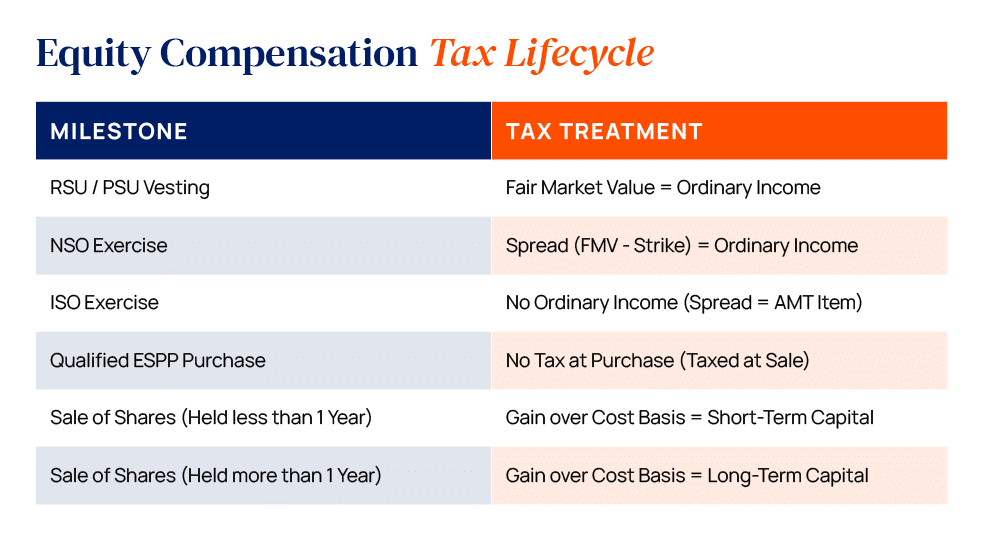
Understanding how the IRS views your equity compensation is the foundation of effective tax planning. Equity awards do not follow the simple tax rules of a standard salary. Instead, they trigger tax events at specific milestones throughout their lifecycle, which makes timing especially important.
- Restricted Stock Units (RSUs) & Performance Stock Units (PSUs)
RSUs and PSUs are promises by your employer to deliver company stock once specific conditions are met.
- The Tax Event: RSUs and PSUs trigger a taxable event on the date they vest and settle.
- The Tax Type: The total Fair Market Value (FMV) of the shares delivered on the vesting date is taxed as ordinary compensation income. This value is included on your W-2 and is subject to federal, state, local, and payroll (FICA) taxes.
- PSU Nuance: PSUs function on a variable scale based on company performance goals (e.g., revenue, EPS, EBITDA, or relative shareholder return). Your final grant payout can range from 0% to 200% of your target grant. If your company overachieves, a larger PSU vest can unexpectedly push you into a significantly higher tax bracket.
- Stock Options: NSOs vs. ISOs
Stock options give you the right to buy company shares at a fixed price (the strike price). The tax treatment depends heavily on whether your options are Non-Qualified Stock Options (NSOs) or Incentive Stock Options (ISOs), so it helps to compare them side by side.
- Non-Qualified Stock Options (NSOs):
- At Grant / Vesting: No tax event.
- At Exercise: Taxable as ordinary income on the spread, the difference between the stock’s Fair Market Value at exercise and your strike price. This spread is subject to W-2 payroll withholding.
- At Sale: Any further appreciation above the FMV at exercise is taxed as a capital gain.
- Incentive Stock Options (ISOs):
- At Exercise: No standard ordinary income tax is owed at exercise. However, the spread at exercise is an Alternative Minimum Tax (AMT) preference item. If the spread is large, exercising and holding ISOs can trigger a substantial AMT liability for that tax year.
- At Sale: If you satisfy the required holding periods, holding the shares for at least two years from the grant date and one year from the exercise date, the entire gain (sale price minus strike price) is taxed at favorable long-term capital gains rates (a Qualifying Disposition). Selling before meeting both milestones results in a Disqualifying Disposition, turning a portion of your profits into ordinary income.
- Employee Stock Purchase Plans (ESPPs)
Qualified Section 423 ESPPs let you buy company stock using post-tax payroll deductions, often at a discount of up to 15% with a lookback provision.
- At Purchase: You owe no tax on the purchase date, even though you received a discount.
- At Sale: Tax is triggered when you sell the shares. Like ISOs, ESPP tax treatment depends on holding periods:
- Qualifying Disposition: Selling shares at least two years from the offering date and one year from the purchase date allows a portion of the gain to qualify for lower long-term capital gains tax rates.
- Disqualifying Disposition: Selling before hitting both holding requirements causes the purchase discount (the spread on the purchase date) to be taxed as higher ordinary income in the year of sale.
What are the Common Mistakes Employees Make Around Equity Taxes?
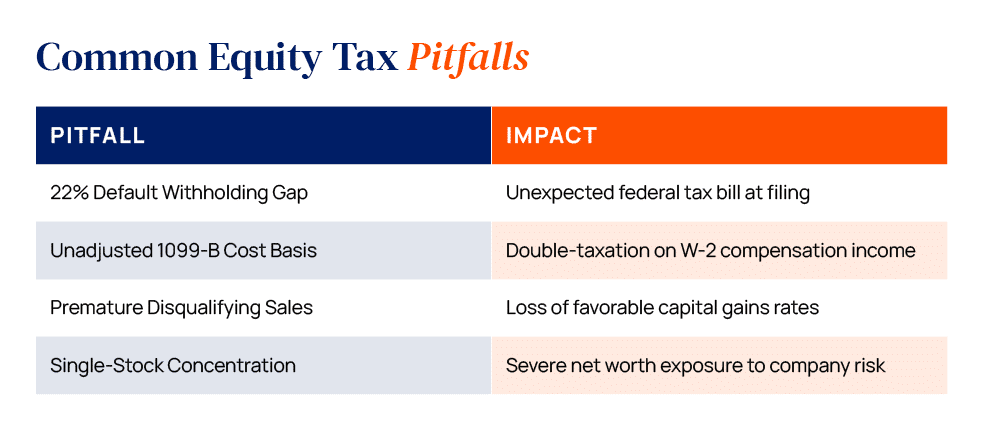
Equity compensation can transform your financial life, but it comes with subtle traps. When navigating year-end planning, employees frequently run into four major pitfalls:
- The 22% Supplemental Withholding Trap
When RSUs vest or NSOs are exercised, employers must withhold taxes. However, the IRS treats equity compensation as supplemental wages. For supplemental income under $1 million, the default federal withholding rate is a flat 22%.
If your total combined income (salary, bonus, and equity) puts you in the 32%, 35%, or 37% federal tax bracket, a 22% flat withholding rate leaves a 10% to 15% tax gap on every single share that vests. High earners who rely solely on automatic employer withholding often face a substantial, unexpected tax bill when filing their returns in April.
- Paying Taxes Twice: The Cost Basis Reporting Error
This is one of the most expensive personal finance errors. When your RSUs vest or options are exercised, the value of those shares appears on your W-2 as ordinary income. You have already paid income taxes on that value, so the next step is to track that amount as your adjusted cost basis.
That exact Fair Market Value becomes your adjusted cost basis for future sales. However, when you sell those shares, your brokerage firm issues a Form 1099-B. Due to IRS reporting rules, the brokerage often reports the cost basis as $0 or lists only the out-of-pocket cash purchase price.
If you or your tax preparer copy the numbers from Form 1099-B directly into your tax return without cross-referencing your supplemental cost basis statement, you will pay tax twice: once as ordinary income on your W-2, and a second time as a capital gain on your 1099-B.
- Mismanaging ISO and ESPP Holding Clocks
Selling ISO or ESPP shares too early triggers a disqualifying disposition, converting what could have been long-term capital gains into higher ordinary income rates. Conversely, holding ISO shares strictly to chase long-term capital gains treatment without evaluating the underlying stock risk can lead to paying AMT on paper wealth that disappears if the stock price drops later, so balance timing with risk.
- Passive Single-Stock Concentration
Holding onto company stock after it vests can feel like the safe option. However, letting your vested RSUs, PSUs, and ESPP shares accumulate over several years often leads to single-stock concentration, where 20%, 30%, or more of your net worth is tied to a single company.
If your employer experiences a downturn, your primary salary, your career growth, and a huge chunk of your personal investment portfolio are all exposed to the same risk.
What Are the Best Practices for Equity Compensation and Taxes?
Year-end planning is about taking control and implementing a proactive strategy before December 31 to avoid tax traps and optimize your portfolio.
- Conduct a Year-End Tax Gap Analysis
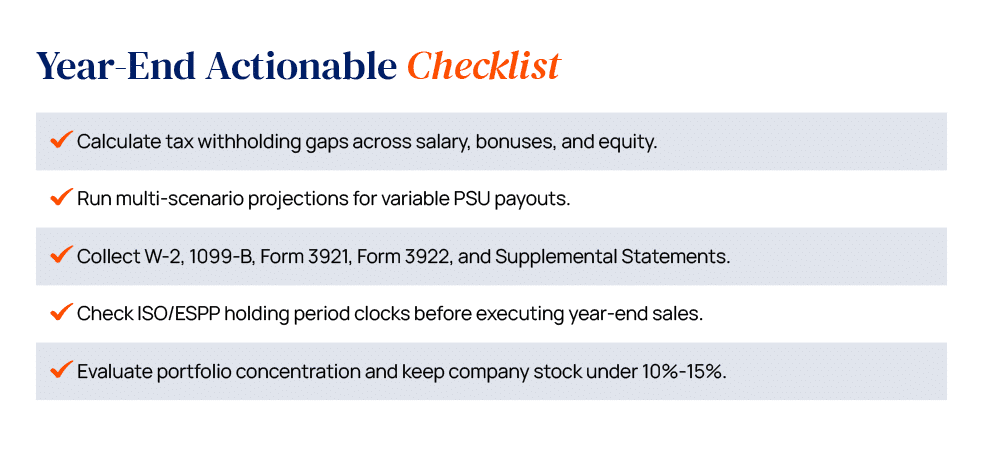
Before December 31, review your pay stubs and total equity vesting events for the year:
- Compare your total estimated income against current federal tax brackets.
- Calculate total federal income tax withheld to date.
- If you discover a withholding shortfall caused by the 22% default rate, work with your financial advisor or CPA to make an estimated tax payment or increase withholding on your final payroll checks of the year to avoid IRS underpayment penalties.
- Model Multi-Scenario Projections for PSUs
If you hold PSUs vesting in the near future, do not build your financial projections on a guaranteed 100% target payout. Model out three distinct scenarios:
- Base Case (100% Target): Standard payout and expected tax liability.
- Low Case (0%–50% Target): Reduced payout impact on cash flow.
- High Case (150%–200% Target): Maximum payout scenario, identifying how much extra cash you must set aside to cover the resulting tax bracket jump.
- Organize Your Tax Documents Early
Create a dedicated folder for your year-end equity documents. Ensure you gather:
- Form W-2: Verifies the compensation income recognized from RSUs, PSUs, NSOs, and ESPPs.
- Form 3921: Documents ISO exercises completed during the calendar year.
- Form 3922: Documents initial ESPP share transfers.
- Form 1099-B: Reports gross proceeds from stock sales.
- Supplemental Cost Basis Statement: Provided by your stock plan custodian (e.g., Fidelity, Schwab, E*TRADE) detailing the exact adjusted cost basis needed to prevent double taxation.
- Treat Vested Equity Like a Cash Bonus
To overcome the emotional friction of selling company stock, ask yourself a simple question on every vest date:
“If my company gave me a cash bonus today equal to the value of my vesting shares, would I go out onto the open market and use 100% of that cash to buy shares of my company’s stock?”
If the answer is no, holding the vested shares means you are making that exact choice every single day. Establishing an automated sell-to-cover or systematic diversification plan lets you treat vested stock like cash, freeing up capital to fund personal goals, pay off debt, or build a diversified investment portfolio.
- Establish a Concentration Risk Rule
Set a strict limit for company stock within your overall net worth. For example, you could keep single-stock exposure to 10% to 15% of your liquid net worth. If your vested holdings exceed this threshold, work with a professional to map out a multi-year, tax-efficient liquidation plan.
Next Steps
Managing your equity compensation successfully requires moving from passive observation to active planning. By understanding how your awards are taxed, preparing for withholding gaps, and maintaining organized records, you can transform complex stock grants into predictable, lasting financial freedom.
What You Learned:
- Equity awards trigger taxation at distinct milestones: RSUs/PSUs at vest, NSOs at exercise, and ISOs/ESPPs primarily at sale.
- The default 22% supplemental withholding rate frequently creates a tax gap for professionals in higher tax brackets.
- Form 1099-B often omits W-2 compensation income, requiring you to use your supplemental cost basis statement to avoid paying tax twice.
- Variable awards like PSUs require scenario planning, as performance multipliers can dramatically shift your taxable income.
- Managing single-stock concentration risk is essential to protecting your long-term wealth from company-specific downturns.
Now What?
- Review Your Paystubs and Vesting Statements: Calculate total equity income recognized this year and check your total tax withholding.
- Identify Potential Tax Shortfalls: Determine whether you need to make an estimated quarterly tax payment before the final January deadline.
- Download Supplemental Custodial Forms: Log into your stock plan portal and locate your supplemental cost basis reports alongside your 1099-B.
- Audit Your Concentration Level: Calculate what percentage of your total net worth is tied up in company stock and establish a diversification plan.
- Schedule a Year-End Strategy Session: Partner with a qualified tax and financial advisor to review your equity strategy before December 31.
Disclaimer: This is not formal tax, finance, or equity compensation advice. Please consult with a tax professional to learn more. This blog was created with AI help and edited by humans. Factual content is believed to be from reliable sources, but cannot be guaranteed. Laws relating to the content discussed may have changed since the article was written. Speak with a qualified professional before implementing any strategies or ideas discussed.