
Executive Summary
An Employee Stock Purchase Plan (ESPP) can be a valuable part of your compensation package, but understanding how it is taxed is just as important as understanding how it works. The timing of when you sell your shares can affect how much of your gains are taxed as ordinary income versus capital gains. This guide explains the key rules behind qualifying and disqualifying dispositions, common tax reporting mistakes, and planning considerations to help you make more informed decisions about your ESPP.
What you’ll learn in this guide:
- The timeline of when ESPP shares are actually taxed.
- The critical difference between a qualifying and disqualifying disposition.
- The most common tax traps employees fall into, including the double tax mistake.
- Strategic best practices for managing your ESPP shares and integrating them into your broader financial life.
Why you should read this: Understanding your ESPP taxes isn’t just about compliance; it’s about keeping more of your hard-earned money. The decisions you make about when to sell your ESPP shares directly dictate how much of your profit goes to the IRS. By understanding the rules now, you may avoid surprise tax bills, prevent costly reporting errors, and confidently turn your company benefits into lasting financial freedom.
How ESPPs are Taxed
The first thing you should know is that for most employees, ESPP shares are taxed at two specific points: sometimes when you buy the shares, but primarily when you sell the shares. Assuming you are participating in a standard tax-qualified Section 423 plan, the tax outcome is almost entirely dependent on how long you hold the stock before selling it.
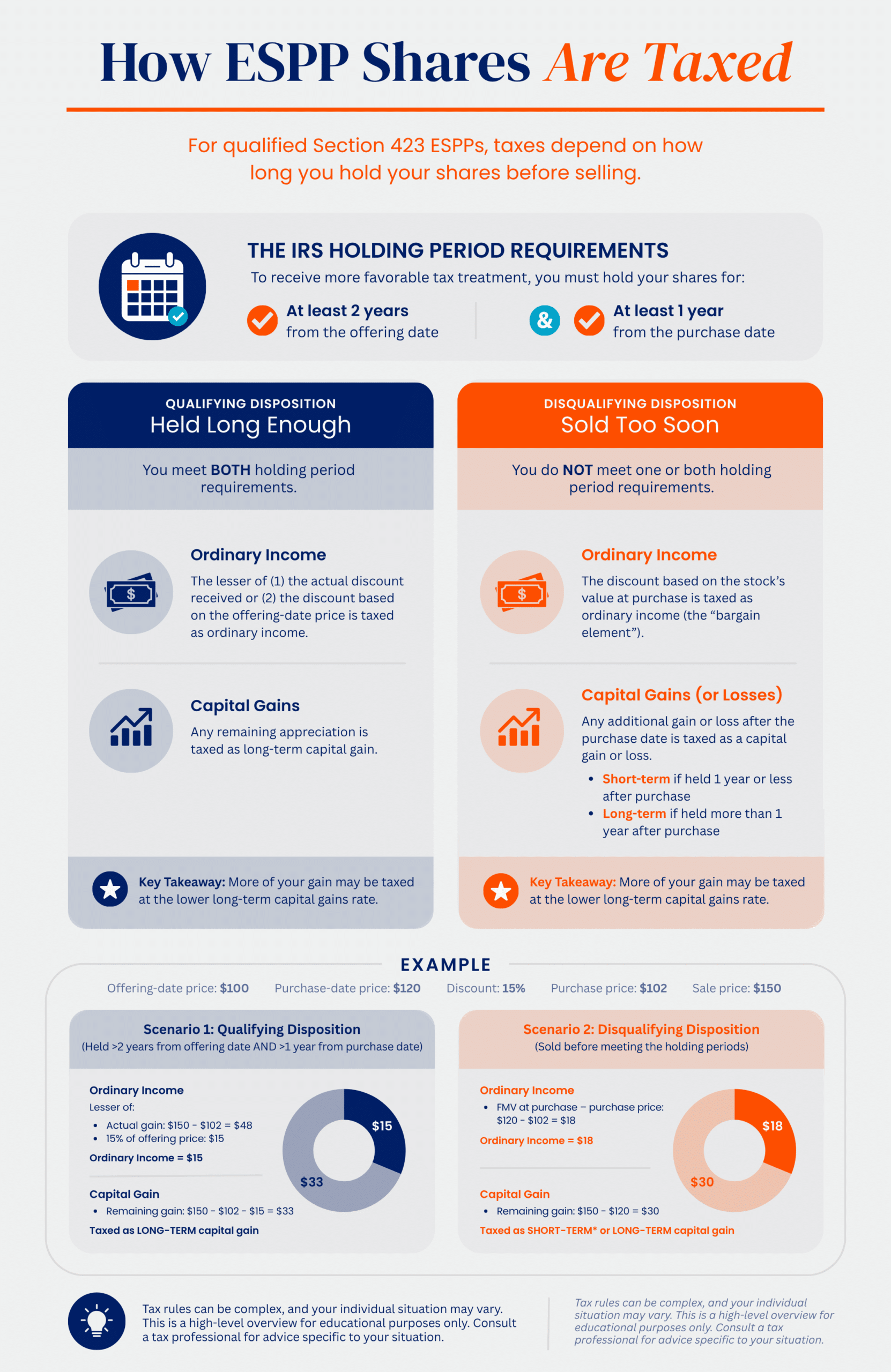
To navigate this, you need to be aware of two critical IRS holding period requirements:
- You must hold the shares for at least 2 years from the offering date (the date the period began).
- You must hold the shares for at least 1 year from the purchase date.
How you meet (or fail to meet) these two clocks determines your tax journey:
- Qualifying Disposition (Holding Long Enough): If you meet both of the holding period requirements above, your sale is considered a qualifying disposition. In this favorable scenario, a portion of your gain, generally the lesser of the actual discount received or the discount based on the offering-date price, is taxed as ordinary income. The true advantage here is that any remaining appreciation is taxed as long-term capital gains, which typically enjoy much lower tax rates.
- Disqualifying Disposition (Selling Too Soon): If you sell the shares before meeting one or both of the holding periods, you trigger a disqualifying disposition. When this happens, the discount based on the stock’s value at the time of purchase (the bargain element) is taxed as ordinary income. Any additional gain or loss after the purchase date is taxed as a capital gain or loss and is treated as short-term (taxed at higher ordinary rates) if you held the shares for one year or less after purchase.
What are the Common Mistakes Employees Make Around Taxes and ESPPs?
ESPP tax rules can be more complex than many employees expect. Understanding a few common mistakes can help you avoid unnecessary surprises when it’s time to sell your shares or file your taxes.
- Falling for the “Double Tax” Trap on Form 1099-B: This is one of the most common and costly errors. When you sell ESPP shares, your brokerage sends you a Form 1099-B. However, the cost basis reported on this form is often incorrect because it may not include the discount income you already paid taxes on through your W-2. If you do not manually correct this using a supplemental cost basis document, you will end up paying tax on the exact same income twice.
- Selling Too Soon Without a Tax Strategy: Employees often sell their ESPP shares immediately to lock in the discount. While this can be a valid strategy for cash flow, doing so triggers a disqualifying disposition, meaning the discount is taxed at higher ordinary income rates. Selling without weighing the tax cost of a short-term gain against the benefit of a long-term capital gain leaves money on the table.
- Ignoring Concentration Risk: Because ESPPs offer a guaranteed discount, employees often hoard the stock. Over time, you may unintentionally build a portfolio where 20% to 30% (or more) of your net worth is tied up in a single company. If your company’s stock declines, your financial stability is at risk.
What are the Best Practices for ESPPs and Taxes?
To master your ESPP, you need to transition from reacting to tax season to proactively planning for it.
- Track Your Holding Periods: Keep a calendar of your offering dates and purchase dates. If you are optimistic about your company’s stock and can handle the market risk, aim to hold your ESPP shares until they meet the criteria for a qualifying disposition (at least two years from offer, one year from purchase) to unlock lower long-term capital gains tax rates.
- Access Form 3922: When it comes time to file your taxes, ensure you have Form 3922 from your employer. This form details the transfer of legal title and the fair market value data you need to accurately calculate your ordinary income versus your capital gains, ensuring you report your discount correctly.
- Balance the Discount with Diversification: A 15% discount is incredibly powerful, but it shouldn’t blind you to risk. Make it a best practice to regularly evaluate how much company stock you hold. If it exceeds 10% to 15% of your total net worth, consider selling shares (preferably tax-efficiently) to reinvest the proceeds into a diversified portfolio.
Next Steps:
You don’t have to do this alone. By understanding the mechanics of how and when your shares are taxed, you can take control of your financial outcomes.
What you learned:
- ESPP taxes are primarily determined when you sell the shares, not when you enroll.
- Holding shares for at least two years from the offering date and one year from the purchase date secures a qualifying disposition, unlocking favorable long-term capital gains rates.
- Selling too early results in a disqualifying disposition, subjecting your discount and short-term gains to higher ordinary income tax rates.
- Brokerage 1099-B forms often report an incorrect cost basis for ESPPs; you must use supplemental documents to avoid paying double taxes.
Now what?
- Locate your ESPP plan documents and identify your specific offering dates and purchase dates.
- Gather Form 3922 and your supplemental cost basis information before filing your taxes.
- Review your overall portfolio to ensure your company stock isn’t creating dangerous concentration risk.
- Work with a professional to map out a clear sell strategy that aligns with your timeline and tax bracket.
- Use this ESPP tax cheat sheet to understand how your shares are taxed based on when you sell them:
Disclaimer:
- Plan Verification: This guide applies explicitly to Qualified Section 423 plans. Employees must verify with their HR department if their plan is qualified or non-qualified, as non-qualified plans face different taxation timing (typically taxed immediately at purchase).
- State Taxes: Tax rules focus on Federal income brackets. State and local tax treatments on equity compensation can vary.
- Not Formal Tax Advice: This content is for educational purposes only and does not constitute formal tax or investment advice. Consult a certified CPA or financial advisor regarding your personal tax situation.